Date : Sunday, 24 May 2015
Time : 22:15
Title : Stay safe everyone!
Time : 22:15
Title : Stay safe everyone!
At the end of the day, how do we exactly prevent ourselves from getting bloodborne diseases? From what we have learnt and discussed in the previous posts, whether we are talking about HBV, HCV or HIV, it is obvious that the basic prevention is to always protect yourself and be careful! As long as you are vaccinated (protecting yourself in a way), you are safe of HBV! As for HCV and HIV, it is all about precaution!

Transmission of bloodborne pathogens in the work setting is a risk wherever workers may have contact with blood or body fluids as a result of their duties. The science is clear. There have been cases of hepatitis B, hepatitis C, and HIV resulting from occupational exposures. All the requirements of the OSHA Bloodborne Pathogens Standard must be followed in any workplace where workers may be exposed to bloodborne pathogens as part of their duties.
Always remember to stay safe! :)

Transmission of bloodborne pathogens in the work setting is a risk wherever workers may have contact with blood or body fluids as a result of their duties. The science is clear. There have been cases of hepatitis B, hepatitis C, and HIV resulting from occupational exposures. All the requirements of the OSHA Bloodborne Pathogens Standard must be followed in any workplace where workers may be exposed to bloodborne pathogens as part of their duties.
Always remember to stay safe! :)

Date :
Time : 21:58
Title : Living With HIV-AIDs -Brryan Jackson's Story
Time : 21:58
Title : Living With HIV-AIDs -Brryan Jackson's Story
He wasn't supposed to live past the age of 6..today he is 23 years old and healthy. St. Louis native Brryan Jackson, was in the hospital for asthma attacks when the unthinkable happened. Here's his story on his life living with HIV-AIDs that his father injected into him.
Date :
Time : 21:52
Title : More about HIV and AIDS
Time : 21:52
Title : More about HIV and AIDS
Let’s discuss a tiny bit more on the effects of HIV.
By now, we know that HIV-infected patients have badly compromised immune systems and thus they can prone to many serious infections and illnesses. Acquired immunodeficiency syndrome (AIDS) is the final stage of HIV. At this stage, the immune system is severely weakened, and the risk of contracting opportunistic infections is much greater. Not everyone with HIV will develop AIDS. The effects of HIV shown in the picture below are due to the failure of immune system with progressive HIV and AIDS. Once the human immunodeficiency virus (HIV) enters your body, it launches a direct attack on your immune system. It gradually weakens your natural defenses against disease and infection and can affect every part of your body. However, with early anti-retro viral treatment, those effects can be prevented.

Overtime, HIV-positive people may experience symptoms from the infection and side effects from their anti-HIV drugs. One long-term effect that some people experience is a change in the way their bodies handle fats and sugars. In some cases, these changes can increase the chances of the patients getting heart disease and diabetes. Some people have experienced visible changes in body shape and appearance.
Experts aren't sure whether these changes in body fat are due to HIV itself, or to the anti-HIV drugs. There are no proven cures at this time, but there are steps people can take to reduce the effects. These include changes in diet, exercise, medication, even plastic surgery.

There is no functional cure for HIV or AIDS, meaning that there is no procedure or medication which has been scientifically proven to reliably eliminate the virus from a person's body or reverse the damage to the immune system. However, there have been many advances in HIV treatments and therapies in recent years that have dramatically improved the quality of life of people with HIV, and more people are living longer with HIV than we used to think was possible. There are now more than 20 approved antiretroviral drugs which can help to keep HIV in check.
There are also individuals who do not progress to AIDS although they did not receive any treatment. These individuals are called elite controllers, as their own immune system is able to maintain virus levels under 50 copies/ml (the detection limit) and stable CD4+ T cell counts.

When considering that there are millions of people living with HIV, there are individuals who hope that there is a new direction for future research in HIV and AIDS. Despite these encouraging developments, HIV continues to pose an extremely complicated challenge to researchers in their attempts to develop a cure. The immune system alone cannot clear HIV from the body because the virus specifically attacks the immune system and mutates away from it. Traditional vaccines have not worked because HIV mutates too rapidly to mount a targeted immune response.
People receiving ART now have a life expectancy approaching normal life expectancy as defined by the World Health Organisation. With what some see as an adequate solution in place, the risk associated with trying a new strategy for a cure seems unnecessary.
By now, we know that HIV-infected patients have badly compromised immune systems and thus they can prone to many serious infections and illnesses. Acquired immunodeficiency syndrome (AIDS) is the final stage of HIV. At this stage, the immune system is severely weakened, and the risk of contracting opportunistic infections is much greater. Not everyone with HIV will develop AIDS. The effects of HIV shown in the picture below are due to the failure of immune system with progressive HIV and AIDS. Once the human immunodeficiency virus (HIV) enters your body, it launches a direct attack on your immune system. It gradually weakens your natural defenses against disease and infection and can affect every part of your body. However, with early anti-retro viral treatment, those effects can be prevented.
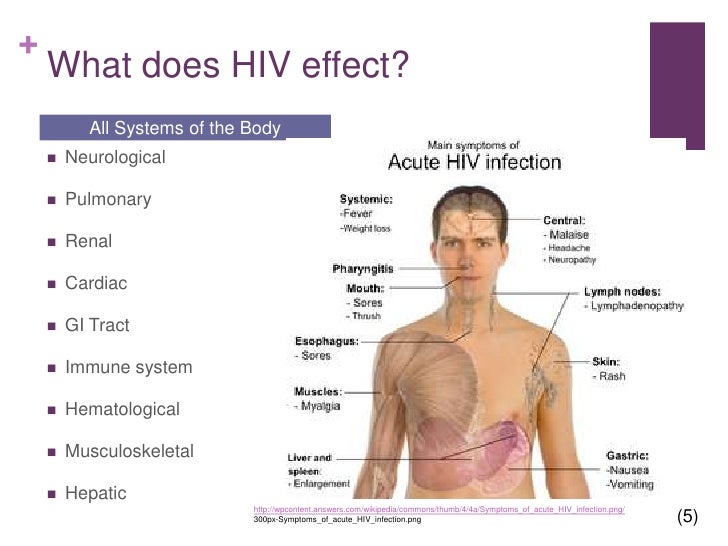
Overtime, HIV-positive people may experience symptoms from the infection and side effects from their anti-HIV drugs. One long-term effect that some people experience is a change in the way their bodies handle fats and sugars. In some cases, these changes can increase the chances of the patients getting heart disease and diabetes. Some people have experienced visible changes in body shape and appearance.
Experts aren't sure whether these changes in body fat are due to HIV itself, or to the anti-HIV drugs. There are no proven cures at this time, but there are steps people can take to reduce the effects. These include changes in diet, exercise, medication, even plastic surgery.

There is no functional cure for HIV or AIDS, meaning that there is no procedure or medication which has been scientifically proven to reliably eliminate the virus from a person's body or reverse the damage to the immune system. However, there have been many advances in HIV treatments and therapies in recent years that have dramatically improved the quality of life of people with HIV, and more people are living longer with HIV than we used to think was possible. There are now more than 20 approved antiretroviral drugs which can help to keep HIV in check.
There are also individuals who do not progress to AIDS although they did not receive any treatment. These individuals are called elite controllers, as their own immune system is able to maintain virus levels under 50 copies/ml (the detection limit) and stable CD4+ T cell counts.
When considering that there are millions of people living with HIV, there are individuals who hope that there is a new direction for future research in HIV and AIDS. Despite these encouraging developments, HIV continues to pose an extremely complicated challenge to researchers in their attempts to develop a cure. The immune system alone cannot clear HIV from the body because the virus specifically attacks the immune system and mutates away from it. Traditional vaccines have not worked because HIV mutates too rapidly to mount a targeted immune response.
People receiving ART now have a life expectancy approaching normal life expectancy as defined by the World Health Organisation. With what some see as an adequate solution in place, the risk associated with trying a new strategy for a cure seems unnecessary.
Date : Saturday, 23 May 2015
Time : 19:38
Title : HIV to AIDS: cures and prevention?
Time : 19:38
Title : HIV to AIDS: cures and prevention?
Date : Friday, 22 May 2015
Time : 15:25
Title : Mechanism of HIV
Time : 15:25
Title : Mechanism of HIV
In the previous post, we got to learn the overview of how HIV virus enters and attacks us. In this post, we will discuss in further detail of the stages of HIV.
As mentioned, HIV targets mainly on CD4 lymphocyte, also called aT-cell or CD4 cell. When a CD4 cell is infected with HIV, the virus goes through multiple steps to reproduce itself and create many more virus particles.
The process is broken up into the following steps:
1. Binding and Fusion: This is the process by which HIV binds to a specific type of CD4 receptor and a co-receptor on the surface of the CD4 cell. This is similar to a key entering a lock. Once unlocked, HIV can fuse with the host cell (CD4 cell) and release its genetic material into the cell.
2. Reverse Transcription: A special enzyme called reverse transcriptase changes the genetic material of the virus, so it can be integrated into the host DNA.
3. Integration: The virus’ new genetic material enters the nucleus of the CD4 cell and uses an enzyme called integrase to integrate itself into your own genetic material, where it may “hide” and stay inactive for several years.
4. Transcription/Replication: When the host cell becomes activated, and the virus uses your own enzymes to create more of its genetic material—along with a more specialized genetic material which allows it make longer proteins.
5. Assembly: A special enzyme called protease cuts the longer HIV proteins into individual proteins. When these come together with the virus’ genetic material, a new virus has been assembled.
6. Budding: This is the final stage of the virus’ life cycle. In this stage, the virus pushes itself out of the host cell, taking with it part of the membrane of the cell. This outer part covers the virus and contains all of the structures necessary to bind to a new CD4 cell and receptors and begin the process again.
To aid your learning, here is an interactive video on the mechanisms of HIV virus in simpler terms and Disney characters! Who says we cannot incorporate Disney characters into our learning? Enjoy!
 |
| Life cycle of HIV |
As mentioned, HIV targets mainly on CD4 lymphocyte, also called aT-cell or CD4 cell. When a CD4 cell is infected with HIV, the virus goes through multiple steps to reproduce itself and create many more virus particles.
The process is broken up into the following steps:
1. Binding and Fusion: This is the process by which HIV binds to a specific type of CD4 receptor and a co-receptor on the surface of the CD4 cell. This is similar to a key entering a lock. Once unlocked, HIV can fuse with the host cell (CD4 cell) and release its genetic material into the cell.
2. Reverse Transcription: A special enzyme called reverse transcriptase changes the genetic material of the virus, so it can be integrated into the host DNA.
3. Integration: The virus’ new genetic material enters the nucleus of the CD4 cell and uses an enzyme called integrase to integrate itself into your own genetic material, where it may “hide” and stay inactive for several years.
4. Transcription/Replication: When the host cell becomes activated, and the virus uses your own enzymes to create more of its genetic material—along with a more specialized genetic material which allows it make longer proteins.
5. Assembly: A special enzyme called protease cuts the longer HIV proteins into individual proteins. When these come together with the virus’ genetic material, a new virus has been assembled.
6. Budding: This is the final stage of the virus’ life cycle. In this stage, the virus pushes itself out of the host cell, taking with it part of the membrane of the cell. This outer part covers the virus and contains all of the structures necessary to bind to a new CD4 cell and receptors and begin the process again.
To aid your learning, here is an interactive video on the mechanisms of HIV virus in simpler terms and Disney characters! Who says we cannot incorporate Disney characters into our learning? Enjoy!
Date :
Time : 00:35
Title : How HIV works
Time : 00:35
Title : How HIV works
Now that we know that HIV virions attacks the human immune system which leads to fatality, how exactly does the virion enter our immune system to weaken it? HIV virions are relatively smart leading to the complexity of how it affects the human body. The simplest way to understand the ways of the HIV virion is through a video!
Before watching the video, i have to warn that there are some really scientific names involved but it will be fun trying to understand the ways of HIV.
Additional Information: CD4 receptors are mostly found on cells like macrophages that make up our immune system.Also, this is how a mature HIV virion would look like.
Before watching the video, i have to warn that there are some really scientific names involved but it will be fun trying to understand the ways of HIV.
Additional Information: CD4 receptors are mostly found on cells like macrophages that make up our immune system.Also, this is how a mature HIV virion would look like.
 |
| gp120 is what the virion uses to bind to the CD4 receptors |
And finally here is the video! (not to worry we will further try to understand the process of HIV infection in the next post)
Date : Wednesday, 20 May 2015
Time : 23:09
Title : Introduction to HIV
Time : 23:09
Title : Introduction to HIV
I'm sure that all of you have heard of “HIV”. What exactly is HIV?
“HIV” stands for Human Immunodeficiency Virus.
HIV is a virus that the human immune system cannot seem to get rid of it. This means that if you are contracted with HIV, you will have to suffer with it for the rest of your life.
HIV can hide for long periods of time in the cells of your body and that it attacks a key part of your immune system. Once HIV invades the immune system, your body will be incapable of fighting infections and diseases.
HIV can be found in the blood, semen, vaginal fluid, and breast milk of infected people. HIV is not as contagious as is often believed. The virus does not survive long outside the body and can only be transmitted through the direct exchange of certain body fluids such as blood, semen and vaginal fluid.
With around 2.5 million people becoming infected with HIV in 2011, there are now an estimated 34 million people around the world who are living with HIV, including millions who have developed AIDS. HIV, the virus that causes AIDS, “acquired immunodeficiency syndrome” has become one of the world’s most serious health and development challenges.
Here is a fun fact of HIV: When HIV jumps from one individual to another, it mutates at a breakneck speed, but it does so 2 to 6 times more slowly than within any single person. Unexpectedly, the virus seems to evolve faster in a single host, than in a population.
 |
HIV- A virus behind AIDS
HIV can hide for long periods of time in the cells of your body and that it attacks a key part of your immune system. Once HIV invades the immune system, your body will be incapable of fighting infections and diseases.
HIV can be found in the blood, semen, vaginal fluid, and breast milk of infected people. HIV is not as contagious as is often believed. The virus does not survive long outside the body and can only be transmitted through the direct exchange of certain body fluids such as blood, semen and vaginal fluid.
With around 2.5 million people becoming infected with HIV in 2011, there are now an estimated 34 million people around the world who are living with HIV, including millions who have developed AIDS. HIV, the virus that causes AIDS, “acquired immunodeficiency syndrome” has become one of the world’s most serious health and development challenges.
Here is a fun fact of HIV: When HIV jumps from one individual to another, it mutates at a breakneck speed, but it does so 2 to 6 times more slowly than within any single person. Unexpectedly, the virus seems to evolve faster in a single host, than in a population.
Date :
Time : 16:18
Title : Prevention and treatments for HBV and HCV
Time : 16:18
Title : Prevention and treatments for HBV and HCV
Hepatitis B is a vaccine-preventable disease. There are safe and effective vaccines to protect infants, children and adults
from hepatitis B. Some examples of HBV vaccines are Recombivax
HB and Engerix-B. Both of these vaccines require three injections administered
over a six-month period. The side effects of the hepatitis B vaccine are usually
mild and may include soreness at the injection site and mild flu-like symptoms.
The HBV vaccine is generally effective for more than 90 percent of adults and
children who receive all three doses. People with compromised immune systems
may be less likely to develop immunity to HBV through vaccination.
Other ways to prevent hepatitis B are to wear gloves when exposed to blood or body fluids and to practise safe sex. Health care workers should follow standard precautions and handle needles and sharps safely. People with acute hepatitis B do not require medical treatment. They would need to make sure that they eat well, drink plenty of fluids and to avoid alcohol and drugs. Medicine is usually not given to a patient unless one is very sick, such as one who is diagnosed with chronic hepatitis B. The goal of treatment is to stop liver damage by keeping the virus from multiplying.
There are now very effective medications such as Interferon-alpha and Adefovir dipivoxil that can suppress the virus over many years. These can slow down the damage being done to the liver, allowing the body to repair itself. However, it is unusual for this treatment to clear the virus permanently. Medicine only slows the ability of the virus to multiply. However, if one has a very serious case of HBV, such as having advanced liver damage, one may need a liver transplant.
The preventions for Hepatitis C are similar to those mentioned for Hepatitis B as both are blood-borne diseases. However, unlike HBV, there is no vaccine to prevent HCV infection. However, if you do not have hep C, there are still preventative measures that can be taken against it. Some measures include not to share needles, Avoid direct exposure to blood or blood products as well as to practise safe sex. Always remember not to share needles as there may be virus present in them that are used with illicit drugs. While the chances of HCV transmission through sexual activity is low, condoms are generally advised to reduce the risk of transmitting HCV, along with HIV and other sexually transmitted infections.
Drugs such as interferon and ribavirin can be used to fight HCV. The cure rate increased tremendously from less than 5% in the 1980s to about 50% by the early 2000s. However, there are side effects to these drugs such as muscle aches, fever, nausea, anxiety, and trouble sleeping.
Below are some videos that elaborate more on the preventions of HBV and HCV, enjoy! :)
Other ways to prevent hepatitis B are to wear gloves when exposed to blood or body fluids and to practise safe sex. Health care workers should follow standard precautions and handle needles and sharps safely. People with acute hepatitis B do not require medical treatment. They would need to make sure that they eat well, drink plenty of fluids and to avoid alcohol and drugs. Medicine is usually not given to a patient unless one is very sick, such as one who is diagnosed with chronic hepatitis B. The goal of treatment is to stop liver damage by keeping the virus from multiplying.
There are now very effective medications such as Interferon-alpha and Adefovir dipivoxil that can suppress the virus over many years. These can slow down the damage being done to the liver, allowing the body to repair itself. However, it is unusual for this treatment to clear the virus permanently. Medicine only slows the ability of the virus to multiply. However, if one has a very serious case of HBV, such as having advanced liver damage, one may need a liver transplant.
The preventions for Hepatitis C are similar to those mentioned for Hepatitis B as both are blood-borne diseases. However, unlike HBV, there is no vaccine to prevent HCV infection. However, if you do not have hep C, there are still preventative measures that can be taken against it. Some measures include not to share needles, Avoid direct exposure to blood or blood products as well as to practise safe sex. Always remember not to share needles as there may be virus present in them that are used with illicit drugs. While the chances of HCV transmission through sexual activity is low, condoms are generally advised to reduce the risk of transmitting HCV, along with HIV and other sexually transmitted infections.
Drugs such as interferon and ribavirin can be used to fight HCV. The cure rate increased tremendously from less than 5% in the 1980s to about 50% by the early 2000s. However, there are side effects to these drugs such as muscle aches, fever, nausea, anxiety, and trouble sleeping.
Below are some videos that elaborate more on the preventions of HBV and HCV, enjoy! :)
Date :
Time : 16:17
Title : HBV and HCV
Time : 16:17
Title : HBV and HCV
A B C D E F G.......
Is the difference between HBV and HCV only a matter of alphabets?
Well, there is definitely more to it. Although both the HBV and HCV virions attack liver cells (hepatocytes), the life cycles of HBV and HCV and how they are harmfu to the human body varies widely.
Hepatitis B is a virus that is unable to attack the hepatocytes by itself. However, the human immune system is able to recognize that HBV virions are foreign particles and aim to destroy them. At the same time, the virions bind to the receptors on the liver cells and enter the cells thru receptor-mediated endocytosis. When the virions are in the human cell, the immune system is unable to differentiate the HBV virions from the hepatocytes leading to the destruction of the liver cells which damages the human liver as a whole. Another way the HBV virus attacks the liver is by mutating the DNA strands in the nucleus of the hepatocytes and most of us would know that mutations is a common cause of cancer.
HCV is also able to trigger the human immune system to attack its own cells but it has a completely different method of damaging the liver cells with its method of Replication
please click on links within the text to view detailed videos to further understand the complexity of the virus infections.
More information @: http://www.hepmag.com/articles/2511_18725.shtml
Is the difference between HBV and HCV only a matter of alphabets?
Well, there is definitely more to it. Although both the HBV and HCV virions attack liver cells (hepatocytes), the life cycles of HBV and HCV and how they are harmfu to the human body varies widely.
Hepatitis B is a virus that is unable to attack the hepatocytes by itself. However, the human immune system is able to recognize that HBV virions are foreign particles and aim to destroy them. At the same time, the virions bind to the receptors on the liver cells and enter the cells thru receptor-mediated endocytosis. When the virions are in the human cell, the immune system is unable to differentiate the HBV virions from the hepatocytes leading to the destruction of the liver cells which damages the human liver as a whole. Another way the HBV virus attacks the liver is by mutating the DNA strands in the nucleus of the hepatocytes and most of us would know that mutations is a common cause of cancer.
HCV is also able to trigger the human immune system to attack its own cells but it has a completely different method of damaging the liver cells with its method of Replication
please click on links within the text to view detailed videos to further understand the complexity of the virus infections.
More information @: http://www.hepmag.com/articles/2511_18725.shtml
Date : Monday, 18 May 2015
Time : 00:16
Title : What are bloodborne pathogens?
Time : 00:16
Title : What are bloodborne pathogens?
As mentioned, the 3 main blood-borne diseases are HBV, HCV and HIV. Though there are no exact cures for these diseases, there are always precautions that we can take right? So here is a short and fun video on the ways that these blood-borne diseases are spread and how we can reduce the possibilities of being infected significantly.
Date : Sunday, 17 May 2015
Time : 12:58
Title : Introduction to blood-borne diseases
Time : 12:58
Title : Introduction to blood-borne diseases
What are
blood-borne diseases? What are they caused by? Generally, the public tend to
associate blood-borne diseases with HIV and AIDS. However, what exactly causes HIV and AIDS?
Blood-borne diseases are caused by blood-borne pathogens
which are infectious microorganisms that are found in human blood that can lead
to disease in humans. These diseases can be transmitted through unprotected
contact with contaminated blood. There are a significant number of blood-borne
pathogens currently known in the medical community.
Depending upon the nature of the causative agents,
blood-borne diseases fall into four categories of which parasites and viruses
are far more prevalent than are bacteria and prions. The three major
blood-borne pathogens are: hepatitis B virus (HBV), hepatitis C virus (HCV), and
the human immunodeficiency virus (HIV), although other diseases can be
transmitted via the blood-borne route of infection. Exposure to blood containing
any of these pathogens carries a risk of transmission of the infection.
While most blood-borne pathogens are spread sexually or
through the use of shared needles for illicit intravenous drug use, they can be
transmitted via accidental needle sticks and other sharp object-related
injuries. Healthcare workers, including doctors, dentists, and nurses, can
become exposed through needlestick injuries, which occur if they are
accidentally pricked with a needle that has been used on an infected person.
Drug users who share needles can also become infected with blood-borne
pathogens, and this is a major route of transmitting HCV. In the past, people
receiving blood transfusions and blood products were also at risk of infection
by blood-borne pathogens.
In the following entries, we will be discussing a few major
blood-borne pathogens in detail and certain precautions to reduce the dangers
of exposure to blood-borne pathogens.